The post The Agility of Open Digital Architecture Imperative for CSPs to Thrive appeared first on Hansen Technologies.
]]>Governments, business and individuals now look to the sector for ongoing agility and expect a similar pace in innovation.
The industry at a crossroads – continue as traditional BSS/OSS or embrace new heights of agility
With the arrival of the internet and Cloud, disruption to the sector was considerable. Telecommunications players needed to rapidly embrace IT agility in ways like they had never before, with new players entering the sector and those that didn’t keep up fading away.
Today, with the advent of 5G, the Internet of Things, AI, autonomous networks, smart cities, open digital architectures, as well as connected mobility and a move towards cloud-native models and AI at scale, the role of communications services providers (CSPs) is once again at a crossroads and being rapidly redefined.
Yet rather than view this as a risk, CSPs that look upon these rapidly shifting sands as an opportunity are poised to play a pivotal role in the near future. They are embracing a far more agile approach to building software for the telecommunications industry, turning away from traditional operations and business support systems (OSS/BSS), and opening a market for standardised, cloud-native software components.
Enter Open Digital Architecture (ODA).
Accelerating next-generation connectivity
In this phase of the digital era, CSPs are under increasing demands to create products and services more rapidly and in a cost-effective way than ever before. What has emerged as a solution to ensuring long-term business agility, through the seamless interconnection of products, is ODA. This is a standardised cloud-native enterprise architecture blueprint for CSPs, vendors and system integrators to help accelerate the delivery of next-generation connectivity.
In this next wave of commerce, CSPs will need to rapidly construct and deliver new digital enterprise-grade services for communities and business ecosystems alike – quicker than ever before, in real-time and in a cost-optimised fashion. The adoption of ODA greatly helps in addressing these complex challenges.
Embracing ODA provides strategic blueprint for radically altered operational approach
All too often, when any kind of disruption or transformation materialises, the fear is that the technology investment will be aggressive. And many parties have been known to dive in without taking a strategic and holistic approach to such shifts.
We believe that wise CSPs will develop a holistic strategy to diversify their business and radically alter their operational approach. What ODA provides, when approached correctly, is the blueprint that not just CSPs but also their suppliers and SIs need to change their IT and network systems. Investing upfront in the strategy helps fast-track the creation of new and differentiated services that will improve productivity, reduce maintenance and integration costs, whilst enhancing the customer experience. In essence, this is your key to modernising your underlying infrastructure and automating your operation.
Is ODA ready for CSPs today?
TM Forum, along with a range of companies, have been working together to create this industry standard and to advance ODA’s evolution to a point where CSPs are now leveraging it.
We are proud to have been both leading and actively working in groups as a member of TM Forum to help the sector reach this point. Specifically, and next to be released into the mix, will be ODA Components and the ODA Canvas.
To unpack this, think of ODA Components as the reusable building blocks which can be used to build business solutions. They interoperate using TM Forum Open APIs and share a common data model, making simplified interoperability a reality. Components run inside the ODA Canvas, which exposes a standard set of services to all components, covering functionality such as observability, management and security. Components from multiple vendors can interoperate seamlessly in a common or distributed Canvas, delivering simplified operations and reducing total cost of ownership.
In fact, at the recent edition of Digital Transformation World, held in June in Copenhagen, TM Forum announced an ODA Component conformance program, offering certification of vendor components.
Very quickly, you can see the importance of ODA, and the benefits to be realised by embracing this technology.
Are technology partners ready?
The early adopters are up and running, and ready to support. ODA increasingly meets the technical and strategic needs of today’s CSPs in their pursuit of highly agile commercial operations.
We believe ODA could very well form a blueprint for CSPs build the structures and ecosystems that will ignite growth in the telecommunications sector and help them at the crossroads they find themselves at today.
[This article was first published in The Fast Mode. It can be accessed here]
The post The Agility of Open Digital Architecture Imperative for CSPs to Thrive appeared first on Hansen Technologies.
]]>The post TM Forum Open API Silver Status – Committed to an Agile Digital Future, Now appeared first on Hansen Technologies.
]]>TM Forum Open APIs, integral to the Open Digital Architecture (ODA), provide standardised interfaces for seamless interaction across communications systems and components. These APIs address key challenges for communications services providers (CSPs) looking to reduce the burden and the cost of software integration. They ensure uniform communication across diverse systems and components, essential for the ODA’s modular setup, as well as simplify integrating new services or switching vendors – thus reducing reliance on any single technology provider.
There are other benefits to being closely aligned to TM Forum Open APIs. By offering a universal language for product integration, Open APIs decrease dependence on specific vendors, enhancing operational flexibility for CSPs. Furthermore, they guarantee system compatibility – crucial as CSPs expand into more varied and sophisticated services. Open APIs also streamline the integration process, cutting down on time and expenses, and are also a critical driver for innovation, allowing for the seamless addition of new applications and services.
Being designated in the Silver tier comes through a TM Forum assessment that ascertains compliance and engagement with TM Forum Open API standards. Achieving Silver status reinforces Hansen’s commitment to TM Forum’s vision of an open and interoperable future. At Hansen, we deem it pivotal to demonstrate this commitment to our customers and the broader market, as CSPs continue to seek the freedom to select and integrate the capabilities essential for running a modern and agile, digitally focused business, including Cloud, AI, 5G mobile, VR/AR and more.
This milestone also reaffirms our dedication not just to meeting these standards but to actively contribute to their development, particularly as we continue to lead the ODA Component Conformance workstream and build upon our recent ‘Ready for ODA’ designation, with our first ODA component scheduled for completion later this year. For the Hansen team, achieving Silver Status is more than just an accolade; it’s a testament to our commitment to future-proofing our offerings, and delivering solutions that not only provide CSPs with the commercial agility needed today but also prepare them for the emerging opportunities and the related complexities.
That age-old saying “Change is constant” is relevant to so much in our lives, and perhaps none more so than the world of communications and CSPs. What this means, in reality, is a future that is open and interoperable. This is the vision of TM Forum.
With this latest milestone and Hansen Catalog being recently certified as ‘Ready For ODA’, we are not only meeting the high standards set before us but also defining the future of digital technology.
The post TM Forum Open API Silver Status – Committed to an Agile Digital Future, Now appeared first on Hansen Technologies.
]]>The post How Hansen is Pioneering the Telecoms Landscape of Tomorrow appeared first on Hansen Technologies.
]]>
Digital Transformation World Copenhagen (DTW) 2023 has wrapped up, offering a treasure trove of practical insights and debates that are reshaping the telecoms sector as we know it. For Hansen, the event presented a prime opportunity to showcase how our advanced solutions are finely attuned to the sector’s rapidly evolving technological landscape. Our VP of Technology Strategy, Brian Cappellani, was on hand to share his expert views. Let’s delve into some of the pivotal themes and insights that caught our attention.
Autonomous Networks
One of the hottest topics of DTW 2023 was autonomous networks. As service providers look for efficient ways to manage the complexities of modern networks, AI and intent-driven capabilities are becoming critical components. This theme aligns closely with the work Hansen has undertaken in the Digital Services Marketplace catalyst, with Cognizant.
Phase five of the Digital Services Marketplace linked in nicely to this theme as this year we focused on Quality of Service (QoS) metrics to guarantee network performance for next-gen applications like smart healthcare and facility management.
By delivering Connectivity-as-a-Service (CaaS), powered by AI, the solution monitors for network anomalies and instigates self-healing mechanisms upon detecting disruption patterns. If an issue arises and the network degrades to outside the SLA, the network automatically provisions the required resources to swiftly restore performance.
With Hansen Catalog as a core foundation to the solution, these service quality attributes can be fully modelled and expressed through the TM Forum 921 intent management API that integrates with AI engines to further enable the autonomous management of network performance.
The Role of AI
Artificial Intelligence is not just a buzzword; it’s a reality that’s transforming how customer journeys and interactions will be managed in the telecoms sector. Hansen used DTW to exhibit the importance of how clean, consistent data is essential for maximising AI’s capabilities, especially within a commercial setting.
We demonstrated this at our booth through our Hansen Informatics platform, which feeds real-time event-based commercial and customer information into AI algorithms. Our showcase involved integration with Google’s Retail recommendation engine and Hansen CPQ. The result was the effortless ability for Hansen CPQ to surface the most relevant products, services and offers to customers, during their journey. Furthermore, with Hansen CPQ omnichannel capabilities, AI-driven enhanced selling capability can be replicated across any sales channel.
New Monetisation Strategies
A pivotal topic at DTW 2023 was the transformation of monetisation models in telecoms, moving CSPs towards becoming Digital Service Providers (DSPs). Captured succinctly by the phrase “From Telco to Techco,” this shift underscores the need for agility and experimentation in market offerings.
There is a great deal of learning to be done over the next few years as 5G and other major network investments need to be monetised, providing greater return on those investments, and CSPs must have the capabilities to learn without excessive expenditure.
This theme plays nicely into Hansen core value proposition as we as a business are uniquely positioned to equip Communication Service Providers (CSPs) with the tools they need to achieve commercial agility – the ability to rapidly respond to market changes and evolving customer needs. The ability to quickly experiment with new market propositions and assess their effectiveness based on metrics is the cornerstone of our solution.
Beyond the Core Themes: TM Forum Standards and Awards
Of course, at any DTW event, there is a focus on the TM Forum standards and initiatives. This year, the spotlight was on the Open Digital Architecture (ODA), and the Component Canvas. Hansen was honoured to receive the prestigious “Ready for ODA” status, a recognition given to only a select few vendors. This award recognises the investment and commitment of Hansen to the Forum’s initiatives and our level of investment, where we have consistently contributed to the evolution of the ODA standards and definitions and are continuing to lead the Canvas conformance workstream. Moreover, this serves as a clear indicator to the market and our customers that Hansen is actively future proofing its technology in alignment with what customers are asking for.
DTW 2023 was an exceptional event that underscored the evolving dynamics within the telecoms industry. The recognition Hansen received, both in terms of awards and the alignment of our technology with emerging themes, demonstrates that we are on the right track. We continue to make strides in providing CSPs with the solutions they need to be agile, efficient, and future-ready.
Hear more from Brian Cappellani, Vice President of Technology Strategy on the future of AI, Automation, and Autonomous Networks and discover Commercial Agility – what Hansen is considering the key to 5G monetisation.
The post How Hansen is Pioneering the Telecoms Landscape of Tomorrow appeared first on Hansen Technologies.
]]>The post Cutting Complexity With Automation And AI: Insights from Brian Cappellani appeared first on Hansen Technologies.
]]>
This marks the seventh edition of this report, spanning a five-year period of surveying the industry on digital transformation. During this time, TM Forum have polled the industry with the same questions, while also focusing on specific items within each report – thus also charting an evolution in CSP and vendor views on digital transformation. There are also interesting sections on Closed-Loop Network Automation and the use of Artificial Intelligence (AI) in telecommunications.
The full report can be found HERE, and a link to the webinar can be found HERE.
In a Hansen article within the report, we present our position on how the use of what we call an ’agile commercial layer’ can help operators improve their transformation success with a solution that aligns to the TM Forum Open Digital Architecture. This solution directly addresses some of the challenges for CSPs that are listed in the report and delivers the benefits they are seeking. One of our diagrams illustrating that layer is shown below:
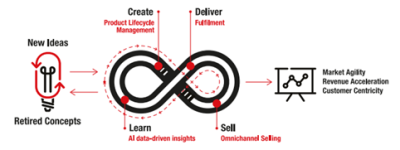
In my view, the report shows that the need and the drivers for products, that we at Hansen specialise in (such as managing complex billing and enabling the agility to quickly create new offerings), are still strong in the industry and deliver the outcomes that the CSP of today needs to succeed.
Here are some of my takes on the content of the report:
It is apparent that COVID-19 drove a lot of digitalisation efforts. To quote the CEO of Telefonica: “During the initial [COVID] confinement, digitalisation advanced as much as it would have done in five years. For, every month of confinement, we made a year’s progress in digitisation.” This is likely the reason that, starting in 2023, it would appear that the pace of transformation decreased from 2022 onwards. But I think the report shows that digital transformation projects continue across the industry.
And the need for transformation does seem to be there. The macroeconomics of the industry aren’t great as operators struggle to monetise 5G and many listed in the report have initiated significant layoffs.
And more may be coming. Transformation means not only modernisation, but also automation – and the resulting efficiencies will reduce the need for staff. The expectation is that the arrival of AI will expedite this expected trend in reduction.
But ironically, CSPs are also struggling to hire. The influx of new technologies and concepts – cloud native, DevSecOps, etc. – need a new type of employee; one who can span both telecommunications and next-generation IT knowledge. To quote BT’s Chief Networks Officer: “I think we’ve got to create a new model – we call them ‘netware’ people. They’ve got to have brilliant network skills and brilliant software skills.”
People with that new way of thinking are hard to find, and in demand across the IT world as well.
Despite all that gloom, the survey shows CSPs to be optimistic about their ability to transform and succeed. The CTIO of Telefonica says: “I [have been] in this industry since the 1980s. This is the first time, to be honest, that I see that we have a common view; we have a common concern.” CSPs seem united in the goal of evolving to become a platform operator – emphasising standards and commonality. They want a better business model where they provide the marketplace, combining partner products and their network capabilities into new and innovative offerings.
But they still suffer barriers getting to that goal. Surprisingly, a lack of vision and the need for culture change are seen as the highest barriers. But complexity of product portfolio and processes, along with inflexible legacy IT technology, still rank high. These are issues that we can directly address with our products and solutions.
There are interesting sections on:
- Intent-based automation, including closed-loop management. This topic is likely worth a blog post all on its own.
- AI and Machine Learning (ML) – Again, a topic worth its own blog post. While there is clearly a focus on AI in network operations, there are also some other good examples on where CSPs can, and are, using AI. But many operators are cautious in implementing AI. And the foundation of good AI and ML is good data – something our systems at Hansen can readily deliver.
Also included in this report is a shout-out to the Zero Touch Digital Marketplace Catalyst project where our products play a key role in ‘powering’ a CSP marketplace. We will be showcasing this at the Digital Transformation World conference in Copenhagen, come September.
What both the TM Forum report and the webinar spotlight, in detail, are the pressing questions that will come up as we make more strides into the AI, IoT, 5G and Big Data era. It may not answer every question (of course), but it does provide something of a good starting point and one that both business and technology leaders should look to explore in further detail – sooner rather than later.
Be sure to check out the full report and watch the webinar.
The post Cutting Complexity With Automation And AI: Insights from Brian Cappellani appeared first on Hansen Technologies.
]]>